
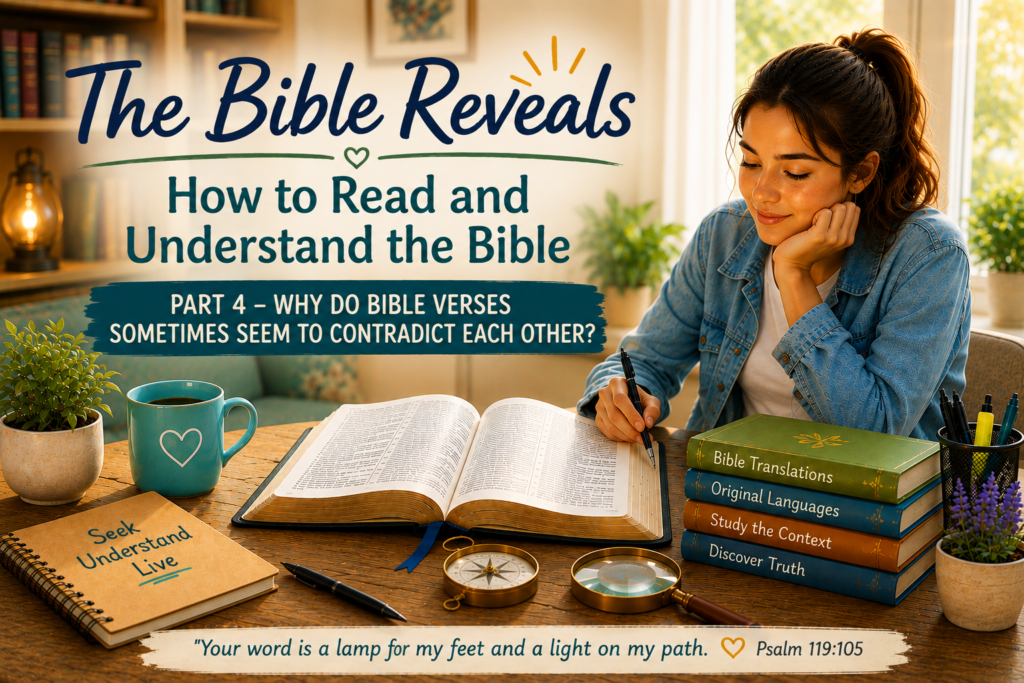
Part 4 – Why do Bible verses sometimes seem to contradict each other?
Does the Bible contradict itself?
Maybe you’ve heard it before.
One person says the Bible is full of contradictions.
Another claims that the Bible forms a single whole.
Who is right?
When you read the Bible quickly, some verses do indeed seem to conflict with each other. But appearances are often deceiving. Just as two witnesses can describe the same accident from a different angle, Bible writers sometimes show different sides of the same truth.
That doesn’t make the Bible unreliable. It actually makes it richer.
The Bible is a single whole
God doesn’t say one thing today and the exact opposite tomorrow.
The Bible says: “God is not a man, that He should lie, nor a son of man, that He should repent.” (Numbers 23:19)
And James writes: “With Him there is no variation or shadow of turning.” (James 1:17)
If God doesn’t change, then His truth doesn’t change either.
When two verses seem to contradict each other, it’s an invitation to investigate further.
Always look at the context
Often an apparent contradiction arises because a text is taken out of context.
Take, for example, the words of Jesus: “Judge not, that you be not judged.” (Matthew 7:1)
Some conclude from this that Christians should never call anything wrong.
But a few verses later Jesus says: “Beware of false prophets…” (Matthew 7:15)
And a bit later: “By their fruits you will know them.” (Matthew 7:16)
That actually requires discernment.
So Jesus doesn’t forbid an honest judgment. He warns against a haughty and judgmental attitude.
The context makes the difference.
Every writer has their own perspective
God used ordinary people to write the Bible.
Matthew wrote primarily for Jews.
Luke focused more on non-Jews.
John puts a lot of emphasis on who Jesus is.
Paul wrote letters to churches with very different problems.
That’s why writers sometimes emphasize different things, without contradicting each other.
Together they form a complete picture.
Faith or good works?
One of the best-known examples is Paul and James.
Paul writes: “For we maintain that a person is justified by faith apart from the works of the law.” (Romans 3:28)
But James says: “You see then that a person is justified by works, and not by faith alone.” (James 2:24)
At first glance, that seems like a contradiction.
Yet both writers are talking about something different.
Paul explains that we cannot save ourselves through good works.
James shows that true faith always becomes visible in our lives.
In other words:
Good works don’t save us, but a living faith doesn’t remain without good works either.
The two texts actually complement each other beautifully.
Let clear verses explain difficult ones
Sometimes we come across a Bible passage that is hard to understand.
Don’t start with all kinds of complicated explanations then.
First ask: What does the rest of the Bible say about this?
Clear verses help explain difficult ones.
That is exactly why we learned in part 2 that the Bible is its own interpreter.
Pray for wisdom
Bible study is more than gathering knowledge.
We need God’s guidance.
James therefore encourages us: “If any of you lacks wisdom, let him ask of God, who gives to all liberally…” (James 1:5)
God promises wisdom to people who sincerely seek Him.
That doesn’t mean we understand everything immediately.
But it does mean that God wants to lead us step by step.
Be patient
Some questions aren’t solved in one evening.
That’s not a problem at all.
Even the disciples didn’t understand everything during Jesus’ life.
Only later did many puzzle pieces fall into place.
Jesus said: “However, when He, the Spirit of truth, has come, He will guide you into all truth.” (John 16:13)
God takes the time to teach us.
We can therefore also be patient.
Summary
Apparent contradictions are often not errors in the Bible, but the result of an incomplete picture.
Therefore, always read the context.
Compare different Bible passages with each other.
Take the writer’s purpose into account.
And pray for wisdom.
Anyone who carefully examines the Bible discovers more and more how wonderfully all the books fit together.
Remember this
A difficult Bible verse is not a reason to distrust the Bible, but an invitation to investigate further. God’s truth never contradicts itself.
Think about it
- Have you ever come across a Bible verse that you found difficult?
- Do you take the time to search further if something is unclear?
- Could it be that an apparent contradiction actually shows a deeper truth?
Prayer
Heavenly Father,
Thank You for Your reliable Word.
Help me not to jump to conclusions when I don’t understand something. Give me patience to search further and wisdom to get to know Your truth better and better.
Would You lead me by Your Holy Spirit, so that I not only understand Your Word, but also apply it in my life.
In Jesus’ name.
Amen.
Next time: In part 5 we discover why the Bible contains so many different types of texts and how to correctly read history, poetry, prophecy, and parables.

