
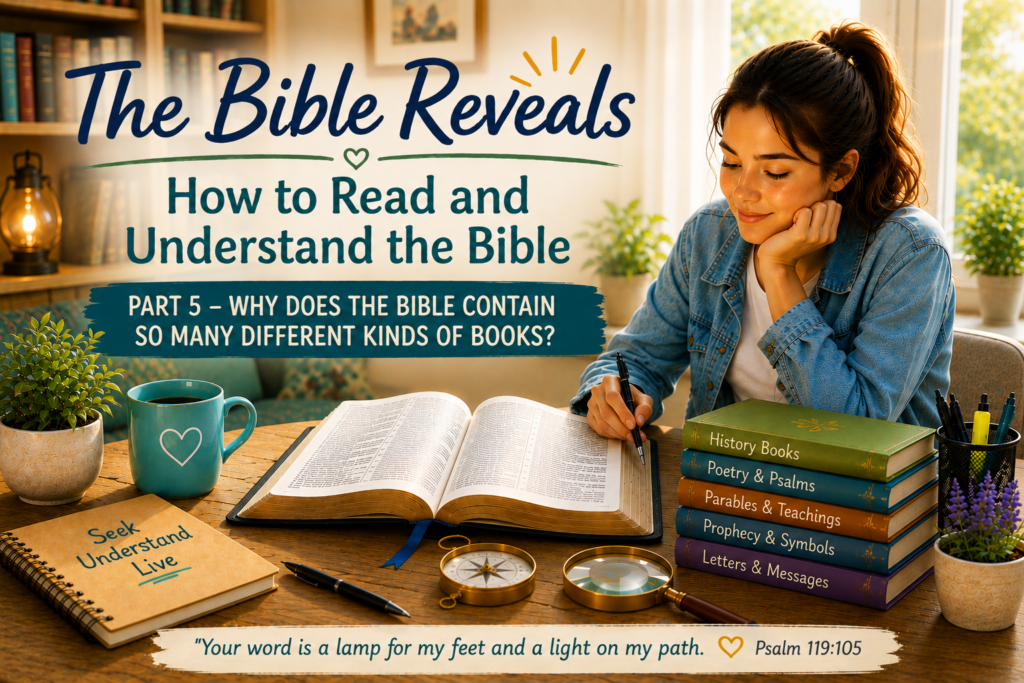
Part 5 – Why does the Bible consist of so many different types of books?
Why is the Bible so varied?
Have you ever noticed how different the books in the Bible are?
In Genesis, you read about creation.
In the Psalms, you encounter songs and prayers.
The Gospels tell the story of the life of Jesus.
Revelation is full of impressive images and symbols.
Why did God do it that way?
Because He knew that people learn in different ways. Sometimes through stories, sometimes through poems, sometimes through history, and sometimes through images that make you think.
It is precisely this variety that makes the Bible so special.
The Bible is a library
The Bible is not one single book, but a collection of 66 books.
Each book has its own purpose, its own style, and its own message.
Yet together they form a single whole.
Paul writes: “All Scripture is God-breathed…” (2 Timothy 3:16)
So that applies to all books, even though they differ greatly from one another.
History tells what happened
Many Bible books describe real events.
Think of Genesis, Exodus, Joshua, Samuel, or Acts.
There you read how God worked in the lives of ordinary people.
Paul says about this: “Now all these things happened to them as examples for us…” (1 Corinthians 10:11)
God had these histories written down so that we can learn from them.
Not everything that happens in a history is automatically an example to follow.
Sometimes the Bible actually shows the consequences of wrong choices.
Poetry speaks to the heart
Books such as Psalms, Proverbs, and Song of Solomon are written differently.
They use imagery.
When David writes: “The LORD is my Shepherd…” (Psalm 23:1)
he obviously doesn’t mean that God is literally a shepherd of sheep.
He uses an image to make God’s loving care clear.
Poetry doesn’t just want to appeal to your mind, but also to your heart.
Parables make you think
Jesus often told parables.
These are short stories with a deep lesson.
His disciples asked Him why.
Jesus answered: “I speak to them in parables…” (Matthew 13:13)
A parable is not a true story, but a comparison that makes a spiritual truth clear.
That’s why you shouldn’t explain every little detail literally.
By doing so, you actually miss the main message.
Prophecies look ahead
Books such as Daniel and Revelation contain many prophecies.
Some are literal.
Others contain symbols.
For example, a beast doesn’t always mean a real animal.
The Bible explains many of those symbols itself.
For instance, we read: “Those great beasts… are four kings…” (Daniel 7:17)
And later: “The waters… are peoples, multitudes, nations, and languages.” (Revelation 17:15)
That shows how important it is not to invent symbols yourself, but to let the Bible speak.
Letters are personal messages
A large part of the New Testament consists of letters.
Paul, Peter, James, and John wrote to congregations that were struggling with very practical questions.
That’s why it’s good to keep asking yourself:
Why did this apostle write this?
Who was this letter intended for?
What situation was going on?
That helps you to better understand and apply the message.
One Author, many writers
Although the Bible was written by about forty people, there is ultimately one Author.
Peter writes: “Holy men of God spoke as they were moved by the Holy Spirit.” (2 Peter 1:21)
God used different personalities, but His message remained the same.
That makes the Bible unique.
Summary
God has given different types of Bible books because each genre makes something different clear.
History shows how God acts.
Poetry touches the heart.
Parables teach us to think.
Prophecies show God’s plan.
Letters help us apply faith practically.
When you know what kind of text you are reading, you understand the Bible much better.
Remember this
Always ask yourself: “What kind of Bible passage am I reading?” You don’t read a history, poem, parable, or prophecy all in the same way.
Think about it
- Which Bible book do you like to read most?
- Do you find history, Psalms, or prophecies most interesting?
- Do you look at the type of text first before drawing a conclusion?
Prayer
Heavenly Father,
Thank You for the richness of Your Word.
Thank You that You speak to people in so many different ways.
Help me to read every Bible book in the right way, so that I learn to understand Your message better.
Give me wisdom, patience, and an open heart to discover more and more of You.
In the name of Jesus.
Amen.
Next time: In the sixth and final part of this series, you will discover how to not only understand the Bible better, but also apply it in your daily life. Because God’s Word is not just meant to be read, but to change your life.

