
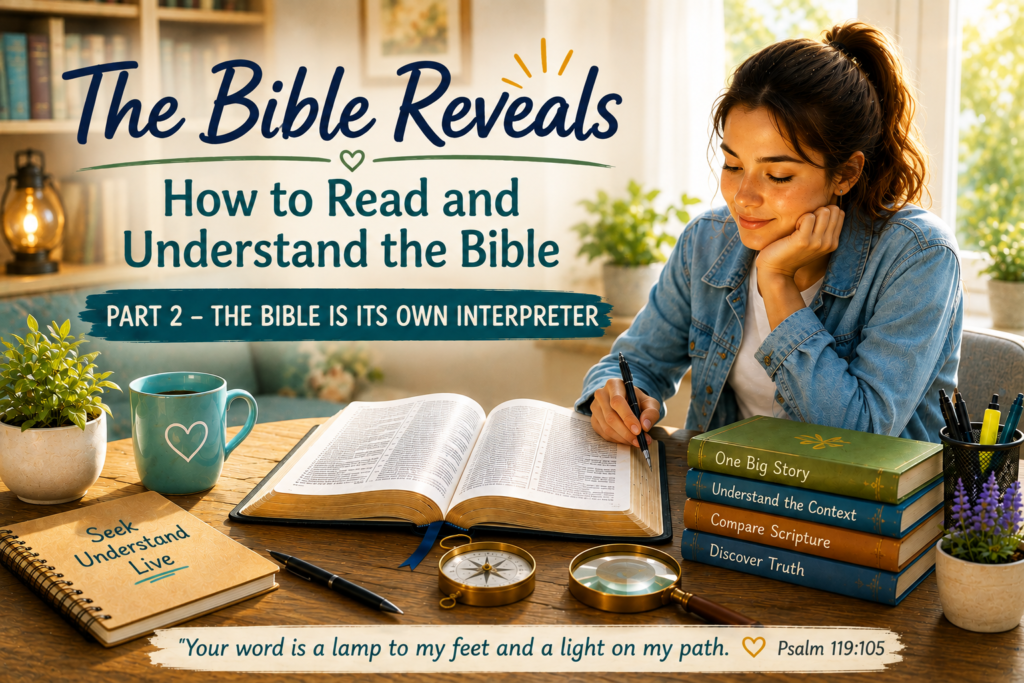
Part 2 – The Bible is its own interpreter
Can the Bible explain itself?
Imagine you’re putting together a thousand-piece puzzle.
You would never look at just one puzzle piece and think you understand the whole picture, right?
Yet that often happens with the Bible.
People read one isolated verse and draw a conclusion from it. But just like a puzzle, one piece never shows the entire image.
God has given His Word in such a way that different Bible passages complement each other. That’s why one of the most important rules for Bible study is:
Compare Scripture with Scripture.
The whole Bible tells the same story
Although the Bible consists of 66 books, it ultimately speaks with one voice.
God does not change.
“Jesus Christ is the same yesterday and today and forever.” (Hebrews 13:8)
“For I am the LORD, I do not change.” (Malachi 3:6)
Because God does not change, He also does not contradict Himself.
When two Bible verses seem to contradict each other, it’s usually a sign that we don’t see the complete picture yet.
Clear passages help explain difficult ones
Not every Bible verse is equally simple.
Peter already knew that too.
“…in which are some things hard to understand…” (2 Peter 3:16)
That’s why you never start with the most difficult text.
First read the Bible passages that speak clearly about the same subject.
Those help you to better understand more difficult sections.
It’s exactly like making a puzzle: first the clear pieces, then the difficult ones.
Jesus did exactly the same
When Jesus was on earth, He constantly explained the Scriptures by bringing in other Bible passages.
After His resurrection, something special happened.
“And beginning at Moses and all the Prophets, He expounded to them in all the Scriptures the things concerning Himself.” (Luke 24:27)
Jesus didn’t use just one verse.
He used the whole Bible.
That is an example for us.
An example
Suppose someone only reads these words: “God is love.” (1 John 4:8)
That is completely true.
But if you only read that one verse, you might think that God never judges justly.
However, if you read the rest of the Bible, you discover that God is not only loving, but also holy, just, patient, and merciful.
All those attributes together give the complete picture of His character.
That’s why it’s dangerous to isolate one verse from the rest of the Bible.
The Holy Spirit wants to help you
Bible study is more than just gathering knowledge.
God wants us to understand His Word.
That’s why He promised His Holy Spirit.
Jesus said: “However, when He, the Spirit of truth, has come, He will guide you into all truth.” (John 16:13)
That doesn’t mean we don’t have to think anymore.
On the contrary.
We can pray for wisdom and carefully examine what the Bible says.
Examine it yourself
The inhabitants of Berea received a wonderful compliment.
“They received the word with all readiness, and searched the Scriptures daily to find out whether these things were so.” (Acts 17:11)
Notice what’s happening here.
Even when an apostle spoke, they didn’t just take his words for granted.
They went to investigate for themselves what the Bible said.
God also encourages you to read for yourself, compare for yourself, and discover for yourself.
The Bible forms one whole
From Genesis to Revelation, you see the same God every time.
The same love.
The same truth.
The same plan of salvation.
The more you get to know the Bible, the more you discover that all the books are connected.
That’s what makes Bible study so special.
Summary
A reliable interpretation of the Bible doesn’t start with one isolated verse.
Always read multiple Bible passages about the same subject.
Clear passages help explain difficult ones.
And never forget that the Bible ultimately tells one big story about God’s love and plan of salvation.
Remember this
Never build your faith on a single Bible verse. Always compare different Bible passages with each other. That way, you let the Bible explain itself.
Think about it
- Do you usually read one verse or a whole chapter?
- Have you ever discovered that another Bible verse provided more clarity?
- Are you willing to examine God’s Word yourself, just like the people in Berea?
Prayer
Heavenly Father,
Thank You for giving Your Word so clearly.
Help me to read the Bible carefully. Teach me not to draw conclusions too quickly, but to patiently examine what You really want to say.
Give me Your Holy Spirit, so that I may understand Your truth better and better and follow it with joy.
In Jesus’ name.
Amen.
Next time: In part 3 we answer the question: Which Bible translation can you trust? And why do so many different translations actually exist?

